

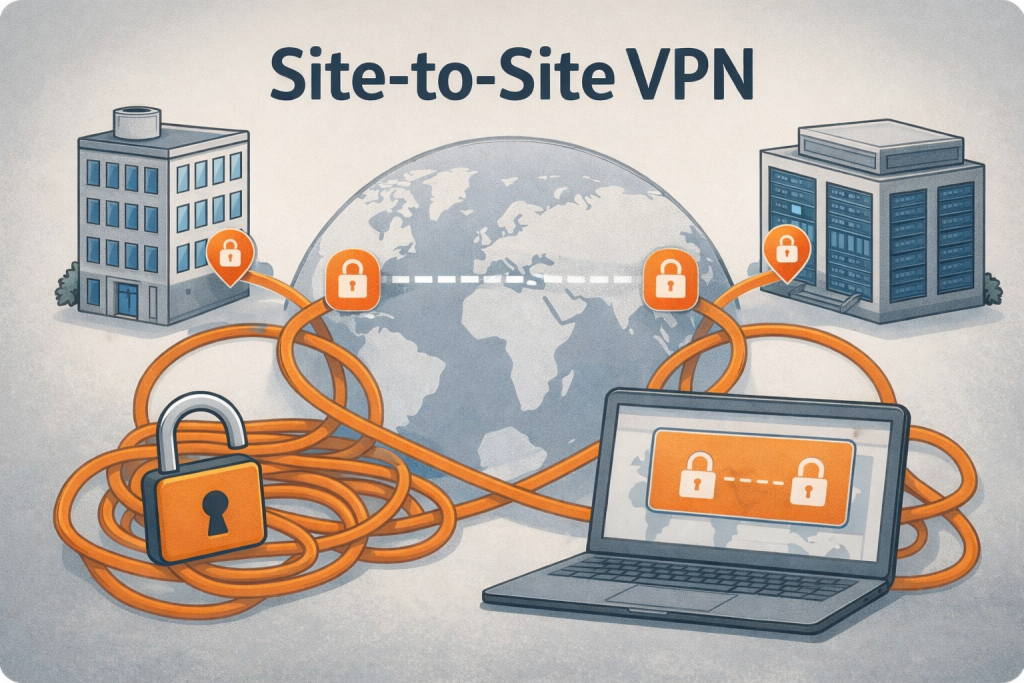

What is a Site-to-Site VPN? A Guide to Secure Network Connectivity with RoltekConnect Cloud
- The Challenge
What is a Site-to-Site VPN?
A Site-to-Site VPN is a type of VPN that allows two or more separate Local Area Networks (LANs) to connect to each other over the internet through a secure and encrypted tunnel.
In this model, it is the networks themselves that are connected, rather than individual users. This allows offices in different cities, production sites, or data centers to function as if they were part of a single private network.
How Does a Site-to-Site VPN Work?
The Site-to-Site VPN architecture consists of three fundamental components:
VPN Gateway
Each location has a VPN gateway (either hardware or software). This device or service represents the local network and initiates the encrypted tunnel.
Encrypted Tunnel
A secure "tunnel" is established over the internet between the two gateways. This tunnel is typically protected using IPsec or modern VPN protocols.
Routing and Network Access
IP ranges for both sides are defined. This ensures that devices on the remote network are accessible as if they were part of the local network.
- End-to-End Encryption
- Persistent Connectivity
- Resource Sharing
- Process
Site-to-Site VPN Setup with RoltekConnect Cloud
Thanks to the RoltekConnect Cloud infrastructure, Site-to-Site connections can be established using both software-based solutions and physical gateway devices.
-
1
Gateway Definition
A VPN gateway is configured for each location (site); hardware or software-based endpoints are integrated into the system.
-
2
Network Configuration
IP ranges are defined and routing rules between networks are optimized to ensure seamless end-to-end communication.
-
3
Secure Tunnel
An encrypted and highly secure tunnel connection is established between gateways using modern protocols.
-
4
Access Policies
Granular access policies clearly define which users or devices can access specific resources.
-
5
Centralized Monitoring
All connection statuses and network traffic are monitored and logged in real time through a centralized control panel.
Difference Between Site-to-Site VPN and Remote Access VPN
| Feature | Site-to-Site VPN | Remote Access VPN |
|---|---|---|
| Connection Type | Network-to-network | User-to-network |
| Primary Use Case | Inter-branch connectivity | Remote employee access |
| Connection Duration | Always-on | Session-based |
| Scale | Multiple sites | Individual users |
- If you want to connect multiple physical locations together, the correct solution is Site-to-Site VPN.
- WHY CHOOSE US?
Why RoltekConnect Cloud for Site-to-Site VPN?
Site-to-Site VPN is one of the fundamental building blocks of modern enterprise network architecture. It meets the need for secure, scalable, and centrally manageable connectivity, especially in multi-location and industrial environments.
RoltekConnect Cloud, with its Zero-Trust architecture and centralized cloud management, transforms Site-to-Site VPN from a simple connectivity method into a part of the enterprise security strategy.

Strong Encryption and Secure Tunnel Infrastructure
Site-to-Site tunnels are protected with strong cryptographic protocols, ensuring that data traffic is securely transmitted over the internet.

Global Cloud Infrastructure
Gateway nodes are optimized across different geographic regions.

Centralized Monitoring and Logging
Session records, traffic analysis, and real-time status monitoring.

Industrial-Grade Gateway Support
Physical VPN device integration for field networks.